Saturday, March 20, 2021

Account overdrawn

In the last episode, our hero said:

"The current plan therefore is to continue to focus on longer distance (I did my first 100K Populaire today) and get that to a reasonable level and then hit the dieting hard once I'm riding 1000+ miles per month. I expect that'll be April at the earliest or more likely May so this means my April brevets are going to be slogfests."

I also said:

"you've got $10 of will power and you can spend it however you'd like. I've been spending it on trying to ride more and longer and don't have any more willpower to spend on dieting".

But it's well known that fat people are impatient, at least this one is, so I started dieting in earnest a week ago today and also did my highest mileage week post-surgery this past week.

Ouch. 

I'm making big withdrawals from the will power account that history suggests I won't be able to sustain too long. Historically, I've hit the dieting really hard for a couple of weeks then have gone to a "normal" but still very restricted diet. In other words I eat the foods I usually eat (sans beer, of course) but very small portions.
 

Here are the results from the last time I did this in 2017:


As you can see, over a period of three months my weight went from 198 to 168. I should note that the big drop in the first week is partially explained by a difference in scales - we went from Wisconsin to Texas that week and I took a smaller digital scale with me which weighs about 3 lbs less than my usual scale. Also, the first measurement period was from the very beginning of one week to the very end of the next so it was almost two full weeks.

So I can do it.

What does a "very restricted" diet mean? An anecdote that I read in Tyler Hamilton's book about when he was losing weight for the TdF was that he'd do a hard 100+ mile ride and when he finished he'd eat two sticks of celery and take a sleeping pill so he could ignore his body screaming for food. For those that don't know, celery is calorie negative: it takes more energy for your body to process it than it provides.

But, as anyone who has ever ridden with me will hasten to tell you, I'm not a pro rider.

Here's a representative sample of my daily intake:

Breakfast

  • Coffee with 1 piece artisan bread (a small 2" x 3" slice)
  • 1/4 cup grapefruit, 1/2 an orange
  • 1 cup mixed fruit, yogurt, granola (so about 1/3 cup of each)

Go ride

Lunch

  • Small slice of ham, 2 eggs scrambled, 1 piece whole wheat toast with butter

 Dinner

  • 1 piece toasted multi-grain bread spread with 1 tbsp peanut butter
  • 1 apple
  • Tea
If it turns out that I finish my ride late enough in the day, I'll skip the dinner "meal" and just have an apple or two. Breakfast and lunch is what I usually have so no real change there. Dinner however is a different story and has always been my downfall for reasons enumerated in my last post.

I've made good progress on the weight loss and increasing the mileage but the consequences are obvious: I'm hungry all the time and very low energy when I ride. Fortunately, I've got enough adipose tissue (sounds better than "fat" doesn't it?) to sustain me through a two hour ride. If I'm riding more than that I'll have an energy bar. I'll likely be able to keep this up for a couple of weeks and then go to a still restricted but somewhat more normal diet with the only real difference being I might have e.g., a bowl of soup for dinner.
 
Miles per week post surgery

So what's my weight goal? Well, I'm not going to give a hard number but let's just say that using the personal standard I discussed in my last post I'm hoping to go from "obese" to the low end of the "fat" range. 
 
I know from history that once I start eating truly normal meals (according to a friend, I apparently provide quite an entertaining spectacle when eating) including the occasional malted beverage that'll be the weight I'll be at and I won't continue to lose no matter how much I ride. I also know that 2-3 months on a restricted diet is about all I can manage.

Stay tuned!


Monday, March 8, 2021

Boy, you're gonna carry that weight


Boy, you're gonna carry that weight
Carry that weight
A long time
The Beatles "Carry that weight"
 
There are few sports that penalize a few extra pounds more than cycling. 5 pounds can make the difference between flying up the hills and having each one be a long slog. I've struggled with weight gain my whole life. Well, strictly speaking this isn't true. I was pretty thin up until after grad school when working 80 hours/week sitting at a desk took its toll. Since then, it's been a constant battle. There are a number of reasons for this:
  1. I'm "gifted" genetically with the metabolism of a hibernating bear.
  2. I have the self control of a 4 year old when it comes to food.
  3. I like the occasional malted beverage.
  4. Although I'm not a glutton, the fact is that I enjoy a good meal.
  5. I was raised in the "clean your plate" generation. Put it in front of me and I will eat until it's gone.
Typically, my weight is a step function: in normal times it's fairly stable for months or years plus or minus a pound or two. When I'm inactive due to injury or travel for a week or more: boom! Plus 5 pounds. And that's my new "normal". I'll remain at this new weight for months until the next time I'm unable to exercise when I add another 5. This process repeats until I reach a level that's unacceptable to me and I go on a "starvation" diet. It's important to note that cycling in and of itself is not enough for me to lose weight, it has to be in conjunction with a fairly restrictive diet.
 
I know what you're thinking: I could of course modify my intake to match my activity level so when it looks like I'm going to have a period of forced inactivity for any length of time I could just not eat/drink as much so I wouldn't gain weight.
 
But that's just crazy! I don't know where you get those nutty ideas!
 
How much "should" I weigh? Well, the US Govt Health and Human Services Dept says that for my height (6'3" or 75") the Body Mass Index (BMI) values are as follows:
  • Underweight - below 18.5
  • Normal - 18.5-24.9
  • Overweight  - 25.0
  • Obesity- 30.0 and above

But that's the government. My personal standard (in pounds) is as follows:

  • 160-170 - ideal
  • 171-180 - a little heavier than I'd like, but I can live with it
  • 181-190 - fat
  • 190+ obese
It probably goes without saying that the repeated and extended times off the bike last year weren't helpful. Right now according to the Government, my weight is "normal" but by my cycling standard I'm obese.

Sigh.

Here's the thing though. My rides post back surgery have been fairly short duration (40 miles or less on average) and low intensity. I've had a few sessions of dieting and basically have accomplished nothing other than making myself miserable. As I've said here in the past: you've got $10 of will power and you can spend it however you'd like. I've been spending it on trying to ride more and longer and don't have any more willpower to spend on dieting. Further, as I said above the "secret sauce" is diet and exercise so on a program of shorter/lower intensity rides I simply won't lose weight, I'll just make myself miserable.

The current plan therefore is to continue to focus on longer distance (I did my first 100K Populaire today) and get that to a reasonable level and then hit the dieting hard once I'm riding 1000+ miles per month. I expect that'll be April at the earliest or more likely May so this means my April brevets are going to be slogfests.

Stay tuned!

Thursday, March 4, 2021

A missed milestone

A lot has been going on lately so not much time for updates. I did realize a while back that the 6 month post surgery milestone has come and gone and have been asked by several friends "how's it going" so I guess I'm overdue.

So how's it going?

There are two dimensions to that answer:

  1. How is my back specifically?
  2. How am I progressing toward "normal" riding and doing brevets?

My back has progressed quite a bit since my last report. I would say most of the pain that I have now is caused by muscle soreness from disuse for several months. I do still have occasional (and significant) pain centered at the S1 but it's usually the result of something "new" i.e., more stress (lifting something heavy), stretching, etc. 

My left foot is numb at the forefoot and left three toes. What's puzzling about this is this can be made worse with hard activity. I'm not surprised that there's residual numbness, nerves take a long time to regenerate and sometimes never do. What is puzzling though is that it can be made worse. My chain of reasoning goes like this:

  1. The numbness was caused by the bulging disc pressing on the sciatic nerve root at the S1.
  2. The surgery whacked off the part of the disc that was pressing on the nerve - it's gone - as revealed by a post surgical MRI.
  3. So if there's nothing pressing on the sciatic nerve, how does e.g., lifting something heavy, make it worse? 

According to my surgeon, there is a 5% probability of reherniation in the first 6 weeks post surgery and I'm well past that. In fact, in my last follow up I literally couldn't get him to say "don't do that". The conversation went like this:

  • Me: can I do strengthening/stretching e.g., planks?
  • Surgeon: Sure
  • Me: can I do hill repeats, hard sprints, etc? 
  • Surgeon: Go for it
  • Me: can I dead lift the front end of a '57 Chevy?
  • Surgeon: all day long

OK, I made that last one up but the point is I'm cleared to do anything within reason and a few things that I thought might have been off limits (hill repeats/hard sprints) so I'm nonplussed that e.g., a hard sprint or sustained hard climb will result in increase numbness in my foot. There's not much to be done about it and I hope that it improves with time but I do find it puzzling. 

I've lost a significant amount of flexibility due to the surgery and resulting dictum not to bend or twist for 6 weeks. I'm working on regaining it (see below) but progress is slow. I used to be able to bend over and put palms flat on the floor at any time, now I can barely reach my ankles and even that with a slow warmup.  

Snowmageddon
On to the second question: how's the riding progressing?

In truth, not all that well. I'm well behind where I was hoping to be on all three axis (weight, distance, intensity). We were caught up in "snowmageddon" in Central Texas which resulted in 10 days of basically sitting in a hotel room, eating restaurant food (take out) three meals a day and staring at the walls. It was so icy we couldn't even walk. We finally said "screw it" and returned home and I've been dismayed by not only how much weight I gained but also by how much riding hurts. I'd worked through to the point that I could do 30-40 miles at JRA pace without suffering too much and I'd done several rides of 60+ miles but that's a distant memory now. Every ride, at any pace, just hurts.

So back at it. I've also thrown increased stretching (specifically aimed at my back, glutes and hamstrings) and some upper body work into the mix so the net is I hurt all over, all the time. I'm dieting (no beer, sigh) and have lost 6 lbs but all that's really accomplished is I lost the weight I gained sitting in the hotel room (I'm a mediocre cyclist but world class at weight gain).

My first brevet, a 200K, is on April 17 in the Quad Cities so I have about 6 weeks to get into some kind of shape. Right now 200K seems impossibly far and I think I'm in for a "season of suffering" as I try to increase the distance. I usually come into brevet season (April) with 3-4K miles in my legs and this year it's going to be more like 1,500 with no rides longer than (hopefully) a century although even that sounds daunting.

Stay tuned!


Monday, January 25, 2021

Preconceptions - and now with more data!

Today's route took me over two of the climbs in the previous post so I collected a little more data. More importantly perhaps, the environmental conditions were exactly the opposite of what they were on my 1/3  ride so rather than a 28 MPH headwind on the Crabapple climb I had a tailwind of similar velocity. It wasn't a full-on tailwind, the steep part of the climb runs toward the SW and the wind was out of the WNW so the North bit helped, the West bit didn't. 

So before I add some follow on thoughts, here's the data with the most recent in red. First the Palo Alto climb:


And then the Crabapple:

The Palo Alto data is in line with previous efforts so not much to talk about there. Faster than all but 2 rides on the Crumpton. 

The Crabapple climb is a bit more intereting. As I said, bit of help on the climb, highest wattage and fastest time of the three outings. It is interesting that the S40 was nearly as fast on fewer watts but it could well be the wind accounted for the difference because as I said in the previous post, the winds were mild on the 16th.

As a wise man once said:

The speed at which you climb on a bicycle is determined mostly by the following factors:

  1. Power, measured in Watts.
  2. How much weight in the total package (bike plus rider).
  3. Aerodynamics.
  4. Drivetrain efficiency.

As can be seen from the data, my power output is similar on both the Cruzbike and the Crumpton. Maybe a small amount lower on the Cruzbike but that might have more to do with measurement than reality. I have Asioma power pedals on the Crumpton and a PowerTap hub on the Cruzbike and it's definitely the case that the farther you get away from the source of the power (your feet) the less accurate it is so this could account for the difference. So let's call it a wash.

I've not done a weigh-off between the two bikes but I'd say that as ridden the Cruzbike is about 8 lbs heavier than the Crumpton. However, the weight of the rider (me) dominates and the difference in bike weight only amounts to about 3%.

At the speeds I'm going, especially on the steeper climb, aerodynamics isn't really a factor. I'd expect an aero advantage to start showing up above 15 MPH and I'm going considerably slower than that.

The drivetrains are essentially identical. The Cruzbike has a very efficient drivetrain unlike a Long Wheelbase (LWB) recumbent like a Bacchetta. 

So the bottom line is there's absolutely no reason for the Cruzbike to be a slower climber than the Crumpton.

If that's the case then why was I convinced it didn't climb as well?

As I said in my previous post, I think it's all down to perception and how your brain processes and interprets motion. On a DF, you're looking down and the ground is rushing by. On a recumbent you're looking essentially straight off into the distance so you gain ground on a reference point e.g., a tree, the top of the hill, etc., much more slowly therefore it "feels like" you're going slower.

There's one other factor: control. The stall speed on a DF is essentially 0 (track stand) whereas below about 5 MPH on the Cruzbike I'm struggling to hold a line. Coincidentally, on both the DF and Cruzbike when I look at my bike computer at the steepest part of the climb I'm going (wait for it): 4.5 MPH. No issues of control on the Crumpton whereas the slightest tug on the bars on the Cruzbike and I'm over in the other lane.

So the conclusion is this: they're roughly equivalent climbers, they're equally suitable for doing brevets and it's entirely possible the aerodynamic advantage of the Cruzbike would win out on all but the hilliest routes where the extra weight penalty might make a difference.

Based on all that, it's likely that I'll do one or more brevets this year on the Cruzbike. My longest ride to date has been 53 miles so I have some work to do to build endurance on it but there's time.

Stay tuned!


Sunday, January 24, 2021

Shattering preconceptions

Let's get this out of the way first: I was wrong.

I've been thinking a lot about the differences between riding the recumbent Cruzbike versus the diamond frame. In general, although I like riding the Cruzbike I always have to add the caveat for a recumbent so I've been trying to figure out why that is. In thinking about it I concluded that it was because of the difference in climbing on a DF versus a 'bent. My conclusions can be summarized thusly:

  1. The recumbent is slower.
  2. The recumbent doesn't suit my natural climbing style.

The first falls into the "conventional wisdom" category. I've read it everywhere on the internet so it must be true. The second point is more personal.

Every cyclist I've ever met has a climbing style that they're most comfortable with. Some people sit in the saddle and grind, some climb mostly out of the saddle. For myself, I'll pedal seated for 100-150 pedal strokes then stand for 25-50 pedal strokes and repeat this process until I reach the top of the hill. I feel that does the best job of recruiting different muscle groups and not overtaxing any particular group.

And of course there's no "out of the saddle" on a recumbent.

As a result, when I'm climbing on the 'bent I feel like I'm just crawling along and grinding my way up the hill. The thought of doing some of the extended climbs I've encountered on brevets e.g., on the High Country in Colorado with 7-10 miles of 7% just seemed unfathomable at best and not something I wanted to do.

As I've said in the past, I'm analytical by nature and a scientist by training so I set out to prove myself right so I could justify to myself why the recumbent just wasn't going to work for brevets.

We've been here in Texas for almost 4 weeks. In that time I've been alternating between the Crumpton (a custom carbon DF bike) and the Cruzbike. Not strict alternation but based more on whim or the route I was going to ride. I'll also note that I've spent a huge amount of time getting the fit of the Cruzbike dialed in. This isn't easy. Moving the seat involves not only determining proper placement but also drilling holes and a certain amount of fabrication. The design of the Cruzbike is such that you "bring the fit to you" i.e., the reach to the pedals, bars, etc., are adjustable but the seat position is relatively fixed. I'd bought a new seat (a Thor Composites Carbon Sport) which gives more support to my back and shoulders and although more comfortable than the stock seat I still felt limited in how far I could ride comfortably. 

So after much work, I've finally got it dialed in. I did a 52 mile route that I've done a number of times on various DF bikes and was completely comfortable - no aching back, neck, shoulders, etc. Of even more interest was that I did my fastest time ever on that route. The layout of the route is the first 12 miles is straight south with a big climb and then a section through town before turning north. I do this route when there's a strong south wind so the first part is a real grind but then I've mostly got a tailwind for the rest.

So yeah, I was faster on the recumbent but then this route is right in its wheelhouse: rolling hills, no big climbs except at the start and a tailwind so the aero advantage of the recumbent would come to the fore. For "real" rides though the fact that the recumbent is a slower climber would dominate. At least that's the thesis that I set out to prove. And hey, I took physics so I know how to make the data support the conclusion ;-)

A few comments before we get to the data. This is taken from normal rides. I wasn't going for KOM's, they weren't maximal efforts, some days I felt good, some days I didn't. Weather conditions varied. I didn't pick one bike over the other when I was feeling peppy, on recovery days, etc. Put simply, the data is representative of everyday riding.

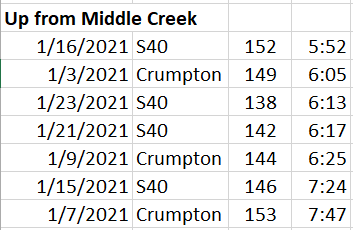
Up from Middle Creek


There's really nothing special about this segment, it's not all that steep (max gradient right at 5%), a little over a mile long and the steepest part is at the end. I usually hit this climb about 5 miles into my ride so I'm reasonably fresh. My general feeling was that the times I'd done it on the DF would generally be faster than the 'bent but not by much. Let's look at the data:

Hmm.... My fastest time is on the Cruzbike (S40). Average power levels are in the same ballpark. Overall, you'd have to say the results are essentially the same with maybe a slight edge to the 'bent.

Up from Palo Alto Creek


Once again, nothing terribly special about this segment. A little shorter, max gradient of about 4% and I usually hit it toward the end of my ride as it's about 2 miles from the cabin. Here's the data:


Here my two fastest times and my highest power is on the DF but comparing the 1/13 and 1/16 rides is interesting. I was within 10 seconds of the same time on about 20% fewer watts. Tailwind maybe? But the 1/23 and 1/21 rides are similar. The overall conclusion though is the data is still essentially split with no strong preference toward either.

I hear you saying "yeah, but these are the sort of climbs that wouldn't bring out the worst of a recumbent. They're not all that steep so not being able to get out of the saddle wouldn't matter" (I really did hear you saying that!). So let's look at something a little steeper.

Crabapple Southbound

 Although the average gradient on this climb isn't all that impressive, this is a bear of a climb. The max gradient is 12.1% and that steep bit is 1/4 mile long - just the sort of climb where you'd jump out of the saddle and lay down the power so the 'bent is going to be seriously disadvantaged. Let's see:

Wait, what? The recumbent is faster? And not by a few seconds either, by 2.5 minutes.

That just can't be.

OK, the sample size is small. Maybe I was feeling peppy when I rode the S40? Maybe I wasn't when I rode the DF? According to the weather data on Strava, the 16th had gusts from the SW at 28 MPH whereas on the 3rd the wind was fairly mild so that was certainly a factor. SW winds would have had me climbing into a headwind and going up a 12% grade into a 28 MPH headwind would certainly slow you down.

But still, I'm astonished at the difference. I would have expected the Cruzbike to be much slower under any and all circumstances. But why do I think that? I know when I'm actually doing the climb on the recumbent I really feel like I'm crawling, working hard to maintain some semblance of control and not weave all over the road.

Here's my theory: when you ride a DF, you're looking down at the ground and it's going by pretty fast, even when climbing. When you ride a recumbent, you're looking at the horizon and it's coming at you pretty slow. This creates the perception that you're going slower even when you are in fact going the same speed or even faster.

What does this all mean? Well, it would certainly lead one to the conclusion that there's not a significant disadvantage to riding the recumbent on any sort of terrain and there might even be an advantage, even on hilly routes. Does that mean I'm going to scrap all of my DF's and go all in on the 'bent? 

In a word, no. There are still the logistical issues associated with travel and recumbents. Also, there's the aesthetic issue. I've said it many times: I'm a diamond frame guy at heart. They touch me on an emotional level in a way that a recumbent doesn't, at least not thus far. Don't get me wrong, I really like the Cruzbike and I like riding it but it's not the same. Maybe I'll get there, maybe not. 

It does show however that the recumbent is a viable option for riding brevets, even hilly ones and more experimentation and data gathering is required. 

And I realized in writing this that I don't think I've ever posted a picture of the 'bent so here you go:


Stay tuned!


Monday, January 4, 2021

Walking a fine line

It's been a while since I've posted an update of my progress and things have been interesting. The good news is that there IS progress. As recently as two weeks ago the summary was:

  • level 1-2 pain 24/7
  • left leg "not working right" - significant cramping in my calf after 10 miles or so on the bike or a mile walking
  • three small toes on my left foot numb constantly. This would spread to my forefoot and lower leg as the distance went up on rides or walks.

 As things currently stand, I actually have periods where none of the above symptoms occur which is significant progress. That's not to say I'm pain free but just being able to do a 20-30 mile ride without increased back pain, calf tightness or numbness is a huge step forward.

But I've found that I'm treading a very fine line. I'm trying to ride more, gradually turning all three "knobs" (distance, frequency, intensity) one at a time and this is definitely an experiment in the truest sense of the word (a test without a predefined outcome). Since we arrived here in Texas I did one stretch of rides at moderate intensity but rode 5 days in a row - no problems. I then took a day off and did a ride where I pushed hard and all of the above symptoms recurred. Here are some pictures that illustrate objectively what I did.

The first is of a Rouvy workout I did on the trainer.

The max watts for that ride was 378 watts and I obviously spent most of the ride in Z2-Z3 so in a range of 122-198 watts. No problems with my back or leg at all and note that this was the last ride in a 5 day stretch without a day off.

I then took a day off and my next ride was outside. Here's the same picture from that ride:

As you can see I spent significantly more time in Z1 (121 watts or less) and a fair amount of time in zones 2 and 3. The key difference though is the harder efforts. In the indoor workout I spent a very small amount of time (2:46) at Z6 (265-330 watts) whereas in the outdoor workout I spent 6:03 at that intensity and 3:19 at an even higher level. My max wattage for that ride was 480 watts.

The more intense ride was most definitely too much, too soon. As I said, I experienced all of the usual symptoms post ride. This all happened yesterday. I rode a fairly easy 33 miles today on the recumbent with no significant issues.

So I'm encouraged. Although a harder effort does have some negative after effects, even the easier rides are at a higher level of intensity than I was able to manage a month ago.

Progress is being made!

I've begun thinking more seriously about 2021 ride plans and have even made a few concrete plans (well, "set in concrete" is a bit of a stretch, more like "set in Jello"). I know my vast readership is on pins and needles wondering what's in store for the year but I'll keep you in suspense for a bit longer.

Stay tuned!


Monday, December 14, 2020

2020 Year in Review

It's that time of year where I look back on how I did versus my stated plans. Here's what I wrote down for my 2020 plans in February:

  • March - Murray 1200K (Australia)
  • April - Hill Country Randonneurs 1000K 
  • April - Okayama 1200K (Japan)
  • May - Brevet series in Wisconsin
  • June - Northern Virginia 1200K
  • June - Sandhills Tour
  • June - Tour of the Driftless 1000K
  • July - Colorado SR600K
  • August - Hokkaido 1200K (Japan)
  • November - Great Southern 1200K (Australia)

So how'd I do against the plan?

HM the Q, said 1992 was her "Annus Horribilis" which if I recall my high school Latin well enough, means "My butt hurts terribly". So taking a cue from the Q, I'm going to go with "Abacus Horribilis" which I think means "wow my back hurts".

Because it does. The good news, if there is any, is that with the exception of the Murray 1200K none of the other rides happened anyway so I didn't miss anything. All things considered, if I was going to choose a year to sit out I couldn't have done much better than 2020.

So I didn't do any of that, what did I do? Here are some stats for the year:

  • 203 rides
  • 5,288 miles (less than half my usual annual total)
  • 1,498 of those miles were on the trainer
  • 1,880 miles on the Cruzbike recumbent
  • 3,408 on various DF bikes

For the visual among you, here's what it looks like as of today. Note that I'll probably get to 500-600 miles before the month is out.


 To recap the key events the chart depicts:

  • Had what I thought was a "Soleus strain" in February. Turns out it was sciatica but I didn't realize it at the time.
  • Blew my back out but good on June 8. Spent the rest of June and most of July in considerable agony (Abacus Horribilis)
  • Rode the recumbent, mostly on the trainer in August. Managed a little over 500 miles.
  • Had back surgery on August 28th.
  • Zip in September. Walked instead.
  • Cleared to ride again on October 9th. Spent the rest of October riding the recumbent on the trainer.
  • Started riding the DF on 11/1, still inside. From then on intervals of riding the DF or recumbent.
  • First outdoor ride on November 3rd. From then on I rode outside when the weather permitted.

So there you have it. If you're of the "glass half empty" school, I did none of the rides I'd planned and only rode about half my normal mileage.

I choose to take a rosier view. Despite persistent problems with my back, surgery and the resulting recovery I'll have managed to ride just under 6K miles by the time the year is out. Not what I'd have chosen but I persevered and did as much as circumstances allowed and perhaps more than was prudent. 

So what's in store for 2021?

Stay tuned!